Answer first: Acupuncture and homeopathy can be part of gentle, whole-person support while you try to conceive naturally or go through IUI or IVF. Neither replaces care from your doctor or fertility clinic, and large studies have not shown that acupuncture raises live-birth rates. What many people value is the support itself: calm, regular time for themselves, care for stress and sleep, and a practitioner who looks at the whole picture. At Core Healing Path in North York, homeopaths Mihaela Rusu and Melissa Montoya work side by side, and Melissa is also a Registered Acupuncturist, so both kinds of care can be planned together around your clinic’s calendar.
Trying to conceive can take over everything: your calendar, your conversations, even the way you read your own body each month. If you live in Toronto or North York, you have probably noticed how many clinics now offer fertility acupuncture, and you may have wondered whether homeopathy has a place too.
This guide brings both together. It explains what each one is (and is not), what a thorough look at the research shows, what to know about the Liz Lalor Fertility Program, how support can be timed around natural cycles, IUI and IVF, and the medical milestones that should never wait for a remedy or a needle.
Two different tools, one whole person
Acupuncture and homeopathy are often mentioned together, but they work in very different ways. Knowing the difference helps you decide what you want from each.
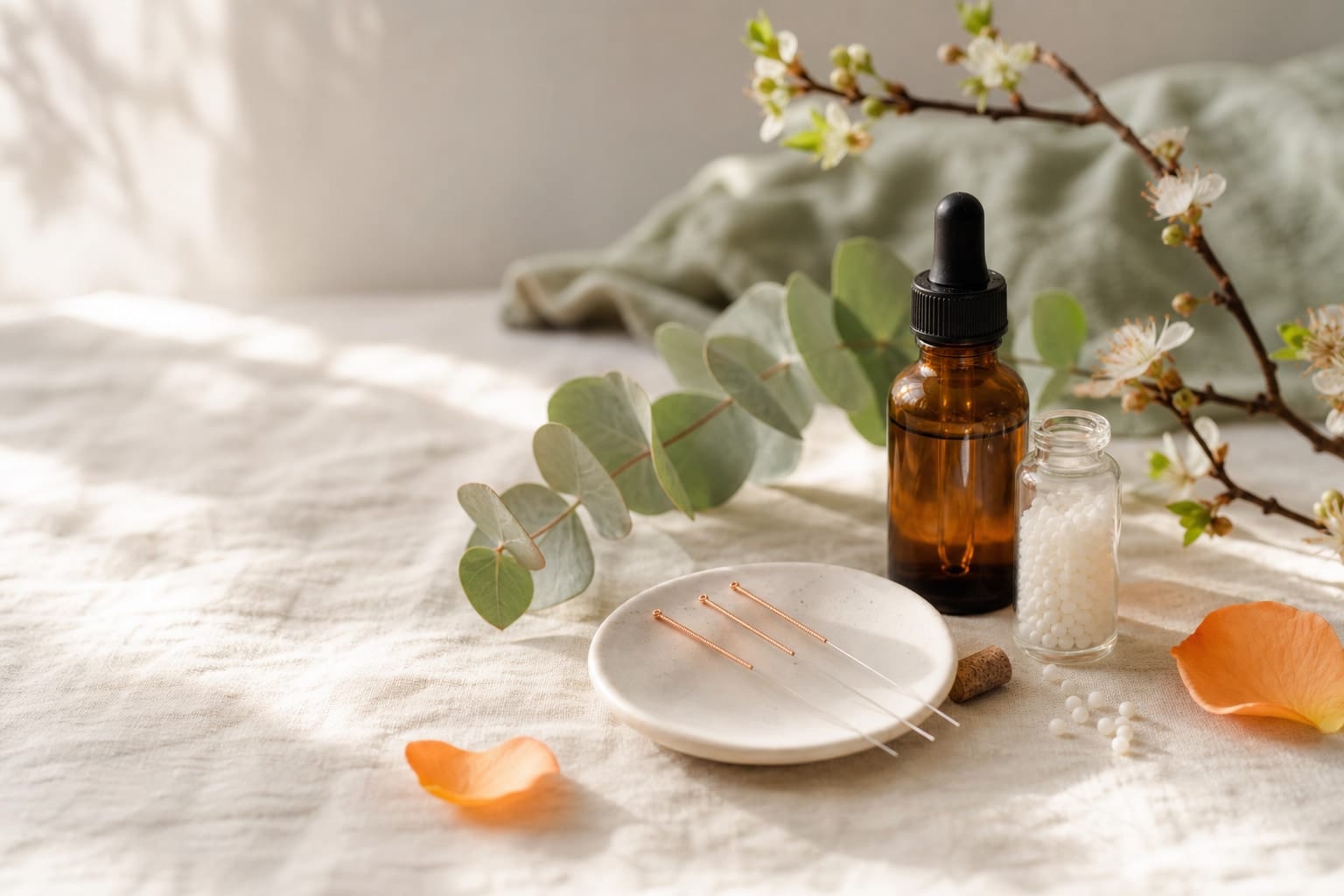
Very fine, sterile, single-use needles are placed at selected points while you rest. In Ontario, Registered Acupuncturists (R. Ac.) are licensed by the College of Traditional Chinese Medicine Practitioners and Acupuncturists of Ontario.
A homeopath takes a detailed history of your physical, emotional and cycle patterns, then chooses one individualized remedy for the whole picture rather than for a diagnosis alone.
Food, sleep, movement and stress shape how you feel from cycle to cycle. Small, steady changes support both partners and fit beside any medical plan.
None of these replace your family doctor, gynecologist or fertility clinic. They sit beside that care, and they work best when everyone on your team knows what the others are doing.
What the research says: a thorough look
You deserve straight answers, so here is the current picture.
Acupuncture and IVF
The largest trial so far, published in JAMA in 2018, followed 848 women having IVF at 16 clinics in Australia and New Zealand. Live births were 18.3% in the acupuncture group and 17.8% in a group that received sham (placebo) acupuncture, a difference too small to matter. Reviews that pool many smaller studies have reached mixed conclusions, largely because those studies were designed so differently.
Acupuncture and PCOS
A 2017 JAMA trial of 1,000 women with polycystic ovary syndrome (PCOS) found that acupuncture did not increase live births compared with a control acupuncture technique, while the fertility medication clomiphene did. If you have PCOS, medical fertility care comes first, and complementary care can sit beside it.
Homeopathy and fertility
There is no reliable research showing that homeopathy improves fertility, pregnancy or IVF success rates, and we will never promise that it will. Some homeopaths have published records from their own practices, such as the figures for the Liz Lalor Fertility Program described below, but no controlled trial has tested them. People who choose homeopathy during this time are usually looking for something different: individualized care for the stress, sleep, mood and cycle symptoms that come with trying to conceive, from someone who listens to the whole story.
Where support still matters
Fertility treatment is demanding. Appointments, injections, waiting and uncertainty take a real toll, and some smaller studies suggest acupuncture may help people feel calmer during IVF. Many people simply value an hour that is about their wellbeing rather than their test results. That is the real promise of complementary care: support for the person going through treatment, not a shortcut around it.
A gentle word of caution: be wary of anyone who guarantees a pregnancy, promises better egg or sperm quality, or suggests pausing medical treatment. Good complementary care is clear about what it can and cannot do.
How homeopathy approaches fertility support
Homeopathy does not start with a remedy list. It starts with you. A first consultation usually covers:
- Your cycle: length, flow, pain, PMS, signs of ovulation and any changes over time
- Your energy, sleep, digestion, temperature preferences and food cravings
- How stress, disappointment or grief show up for you, and what helps
- Your health history, any past pregnancies or losses, and the plan from your fertility clinic
From that whole picture, the homeopath chooses one remedy that matches your pattern, then reviews and adjusts it at follow-up visits. This is what we mean by true-to-you care: two people with the same diagnosis may receive completely different remedies.
Remedies often discussed in women’s health
The remedies below appear often in homeopathic writing on women’s health. They describe traditional symptom pictures, not proven fertility treatments, and they are not a shopping list.
| Remedy | Traditional symptom picture | Read more |
|---|---|---|
| Sepia | Feeling depleted, irritable or detached; low desire; a heavy, dragging feeling in the pelvis; often better for vigorous exercise. | Sepia guide |
| Pulsatilla | Gentle, changeable moods and tearfulness with a strong wish for comfort; late, light or changeable periods; better in fresh air. | Pulsatilla guide |
| Natrum muriaticum | Disappointment or grief held quietly inside; dislikes fuss or sympathy; headaches; craves salt. | Natrum muriaticum guide |
| Ignatia amara | Acute grief or shock, such as after a negative test or a loss; frequent sighing; a lump-in-the-throat feeling; changeable emotions. | Ignatia guide |
| Calcarea carbonica | Feeling overwhelmed and worried about the future; chilly and easily tired; heavy or early periods. | Calcarea carbonica guide |
Taking a remedy because it appears in an article rarely gives a clear result, and combining several makes it hard to know what is changing. If you are curious, bring your questions to a homeopathic consultation with Mihaela or Melissa. Our homeopathy page explains how we work.
What about the Liz Lalor Fertility Program?
If you have searched for homeopathy and fertility, you have probably come across the Liz Lalor Fertility Program. Liz Lalor is a homeopath in Melbourne, Australia, who has been in practice since 1980 and is the author of A Homeopathic Guide to Partnership and Compatibility and Homeopathic Psychiatry. She developed her fertility program in the late 1990s and has since taught it to homeopaths around the world. Our own Mihaela Rusu has taken some of her classes.
A set sequence instead of one individual remedy
Most homeopathic care, including the approach described above, matches one remedy to your whole individual picture. Lalor’s program works differently. It builds on the drainage approach of the French homeopath Dr. Léon Vannier (1880–1963) and uses a set sequence of remedies, each taken at a particular point in the menstrual cycle. Lalor has been open that this is standardized prescribing: she says the sequence grew out of finding herself choosing the same remedies, in the same order, case after case. She first designed it for women who were not ovulating regularly, especially after years on the birth control pill.
Remedies named in published descriptions of the program include Folliculinum, Thuja, Natrum muriaticum, Borax, Sepia and Pulsatilla. Sepia, Pulsatilla and Natrum muriaticum also appear in the table above, but here they are used in a fixed order rather than chosen for one person’s symptom picture.
More than remedies
In published descriptions, the remedies are only one part of the program. The rest is practical support:
- Charting your cycle and using ovulation tests, so you know your most fertile days
- A prenatal multivitamin with folate, plus diet and lifestyle changes for both partners
- Attention to the strain that trying to conceive can put on a relationship, including keeping intimacy enjoyable rather than scheduled
- Regular check-ins, usually monthly
Lalor’s original version also used herbal and nutritional supplements. If you are in a medical fertility cycle, check every herb and supplement with your clinic first, because some can interfere with fertility medication.
Clear limits, agreed at the start
One part of Lalor’s approach we especially respect is how clear she is about time. She has written that she works with a couple for no longer than about four months and sets out that limit at the very first consultation, because it is “crucial to not promise something that you can not deliver.” If there is no pregnancy by then, she believes the couple should move on to medical fertility treatment rather than keep waiting. Practitioners who use her program say it is not suitable while breastfeeding, when there are no viable eggs or when no sperm are produced, and they are cautious about using it after about age 42.
What the published numbers can and cannot tell you
Lalor has published figures from her own practice, first in Homoeopathic Links in 2005 and most recently in a 2022 update in Similia, the Australian Journal of Homoeopathic Medicine, written by Sydney homeopaths Sarah Saunders and Linlee Jordan. The update reports 416 babies born and 56 unsuccessful cases in her practice from 2003 to 2021, which is where the often-quoted 87% success rate comes from.
These are records from one practitioner’s clinic, not a clinical trial. There was no comparison group, so they cannot tell us how many of those couples would have conceived anyway: most couples conceive within a year of trying, and many people who seek help are also tracking their cycles, changing their diet or going on to IVF at the same time. Until the program is tested in a controlled trial, the figures describe one homeopath’s experience, not proof that the remedies cause pregnancy.
Is a program like this right for you?
A set sequence and individualized prescribing are two different philosophies within homeopathy, and experienced homeopaths disagree about which suits fertility support best. At Core Healing Path, we start with your whole individual picture. If you have read about the Liz Lalor program, bring your questions to a consultation with Mihaela and she will talk it through with you thoroughly, including whether it suits your situation and your clinic’s plan. Please do not try to piece the sequence together yourself from articles: remedies and timing should be chosen in a consultation, and your fertility clinic should know about everything you take.
What a fertility acupuncture visit looks like
A first visit begins with a conversation about your health, your cycle and your goals, including any plan from your fertility clinic. Then very fine needles, much thinner than the ones used for blood tests, are placed at selected points while you rest. Most people feel a light tingle, a dull ache or very little at all, and many find the time deeply relaxing. If you are nervous about needles, say so: treatment can start gently.
Plans vary from person to person. Many people like to start two to three months before a planned cycle, so a routine is in place before treatment gets busy, but you can also begin partway through a cycle. Melissa will suggest a plan after your first visit and adjust it as things change.
How support can fit each stage
| Stage | Acupuncture | Homeopathy & nutrition | Keep in mind |
|---|---|---|---|
| Two to three months before trying or before a cycle | Start a regular rhythm of sessions while life is calmer. | A full homeopathic consultation; nutrition basics for both partners. | Book a preconception check-up and start folic acid. |
| Trying naturally or IUI | Sessions planned around your cycle and any monitoring appointments. | Follow-ups to review sleep, stress and how your cycle is going. | Track your cycle and know when to ask for a referral. |
| IVF stimulation and retrieval | Calm, supportive sessions scheduled around your clinic’s instructions. | Support for stress and sleep, with no changes to prescribed medication. | Call your clinic right away about severe bloating or pain, rapid weight gain or shortness of breath. |
| Transfer and the two-week wait | Gentle sessions, with points and techniques adjusted for a possible pregnancy. | Support for the anxiety and emotional strain of waiting. | Start no new herbs or supplements without your clinic’s approval. |
| After a negative cycle or a loss | Space to rest and reset at your own pace. | Care for grief, disappointment and sleep. | Ask about counselling; Fertility Matters Canada and the PAIL Network offer peer support. |
Foundations for both partners
Eggs and sperm mature over roughly three months, so the habits you build now matter. Health Canada recommends that anyone who could become pregnant take a daily multivitamin with 0.4 mg of folic acid; your doctor may suggest a different dose based on your history. Beyond that, the basics are simple: regular meals built around whole foods, steady sleep, moderate caffeine, no alcohol or smoking, and movement you enjoy.
Fertility is a shared journey. Partners can make the same changes, and a semen analysis is one of the simplest early tests, so it is worth asking your doctor about it sooner rather than later. For more detail, read our guide to nutrition and supplements for fertility in men and women, or explore holistic nutrition with Mihaela Rusu, our homeopath and holistic nutritionist.
When to see a fertility doctor
Complementary care should never delay a medical assessment. Ask your family doctor or nurse practitioner about a referral to a fertility clinic if:
- You are under 35 and have been trying for 12 months without a pregnancy
- You are 35 to 39 and have been trying for six months
- You are 40 or older: talk to your doctor as soon as you start trying
- Your periods are very irregular or absent, or you have PCOS, endometriosis or a thyroid condition
- You have had two or more pregnancy losses, pelvic surgery or a pelvic infection
- There is a known sperm concern, or your partner has had treatment or an injury that may affect fertility
Ontario also funds some fertility treatment for eligible residents through the Ontario Fertility Program. A fertility clinic can explain what you qualify for.
Seek urgent care if you might be pregnant and have severe one-sided pelvic pain, heavy bleeding, shoulder-tip pain, dizziness or fainting. These are not symptoms to manage at home.
Acupuncture and homeopathy together in North York
At Core Healing Path, two homeopaths work side by side. Melissa Montoya, HOM, DSHM, R. Ac., is also a licensed Registered Acupuncturist in Ontario, with a particular focus on women’s health, so your acupuncture and homeopathic care can be planned together by one practitioner who knows your whole story. Mihaela Rusu, CCH, HOM, RHN, is a classical homeopath and holistic nutritionist who offers homeopathic consultations and nutrition support for both partners.
- One plan around your clinic: share your clinic’s calendar and we will plan your visits around it.
- Whole-person care: your cycle, sleep, digestion, stress and emotions are all part of the picture.
- Your choice of homeopath: see Mihaela or Melissa for homeopathy, and Mihaela can also help both partners make practical, lasting food changes.
- Respect for your medical team: we never ask you to stop or change prescribed treatment, and we are glad to work alongside your doctor or fertility clinic.
Acupuncture visits take place in person at 333 Sheppard Ave E, Suite 5W, in North York. Homeopathy and nutrition consultations are available in person or online. Learn more about homeopathy in Toronto, acupuncture for women’s health and acupuncture in North York, or meet Mihaela and Melissa.
Frequently asked questions
Can acupuncture help me get pregnant?
Large, well-designed trials have not shown that acupuncture increases live births during IVF or for women with PCOS. Many people still choose it as calming, supportive care while they try to conceive or go through treatment. It belongs alongside medical fertility care, never instead of it.
When should I start acupuncture before IVF or IUI?
Many people start two to three months before a planned cycle so a routine is in place, but you can begin at any point, including partway through a cycle. Bring your clinic’s calendar to your first visit so sessions can be planned around it.
Can I take homeopathic remedies during IVF?
Many people use homeopathy alongside fertility treatment. Tell your fertility clinic about every remedy, herb and supplement you take, and never stop or change prescribed medication. A remedy should be chosen for your individual picture rather than taken from a list.
What is the Liz Lalor Fertility Program?
It is a homeopathic fertility program developed by Melbourne homeopath Liz Lalor. It uses a set sequence of remedies timed to the menstrual cycle, together with cycle charting, nutrition and lifestyle support, usually for about four cycles. Lalor has published figures from her own practice, but the program has not been tested in a controlled trial, and it does not replace a medical fertility assessment. At Core Healing Path, Mihaela Rusu has taken some of Liz Lalor’s classes and can answer your questions about it.
Is acupuncture safe during the two-week wait or early pregnancy?
Acupuncture can be received during pregnancy, but certain points and techniques are modified. Always tell us if you are pregnant, might be pregnant, or are in an active fertility cycle when you book.
Can my partner have treatment too?
Yes. Fertility involves both partners, and partners are welcome to book acupuncture, homeopathy or nutrition support. A semen analysis through your doctor is a simple and important early step.
Is fertility acupuncture covered by insurance in Ontario?
OHIP does not cover acupuncture, but many extended health plans include treatment by a Registered Acupuncturist, and some also cover homeopathy or nutrition visits. Check your plan before you book.
Thinking about fertility support in North York?
Book a free 15-minute consultation to talk through where you are, what your clinic has planned, and whether acupuncture, homeopathy or both feel right for you. You can also call Melissa at +1 (647) 671-1619.
About the authors: Melissa Montoya, HOM, DSHM, R. Ac., is a homeopath and licensed Registered Acupuncturist at Core Healing Path in North York, with a particular focus on women’s health and pain. Read Melissa’s bio.
Mihaela Rusu, CCH, HOM, RHN, is a classical homeopath and holistic nutritionist at Core Healing Path who has taken some of Liz Lalor’s classes. She co-authored the homeopathy guidance in this article. Read Mihaela’s bio.
Disclaimer: This article is for general education and is not medical advice, diagnosis or treatment. Acupuncture and homeopathy do not replace care from your doctor or fertility clinic, and neither can guarantee a pregnancy. Speak with your medical team before changing any part of your fertility plan, and seek urgent care for severe pain, heavy bleeding or other worrying symptoms.